PERSONAL FINANCE
Financial Resolutions for the New Year
What you'll learn: How to set and achieve financial resolutions for the new year.
EXPECTED READ TIME: 9 Minutes
New year, new you.
The new year is your chance to stop wishing for better financial health and start building it. Forget rigid, boring resolutions that fizzle out before Q1 is even over. Thriving in 2026 is all about leaning into these smart, sustainable practices:
- Create your game plan
- Build a realistic budget
- Crush debt
- Strengthen your safety net
- Automate your future
Design Your 2026 Financial Game Plan
Let’s talk briefly about last year’s resolutions and where Americans stand on goal setting. According to a 2025 Motley Fool survey, 54% of respondents didn’t think they would be able to see 2025 resolutions through because it would have been too expensive. Respondents also admitted that they hadn’t established the necessary habits to get them there, they felt financially overwhelmed from caring for dependents, or they simply couldn’t find the time.
All valid reasons, but we’re here to help you find balance and stay committed even with life coming at you.

If you want to run a marathon, you don't just show up to the event — you get familiar with the route, make a mental note of mile markers, and follow a training schedule. The same goes for those big, exciting goals like buying a new car, launching a home renovation project, or maxing your kid’s college fund. Your financial game plan is what transforms the grand vision into simple, micro actions you can start today.
Your financial game plan is what transforms the grand vision into simple, micro actions you can start today.
How to Reframe Your Goals
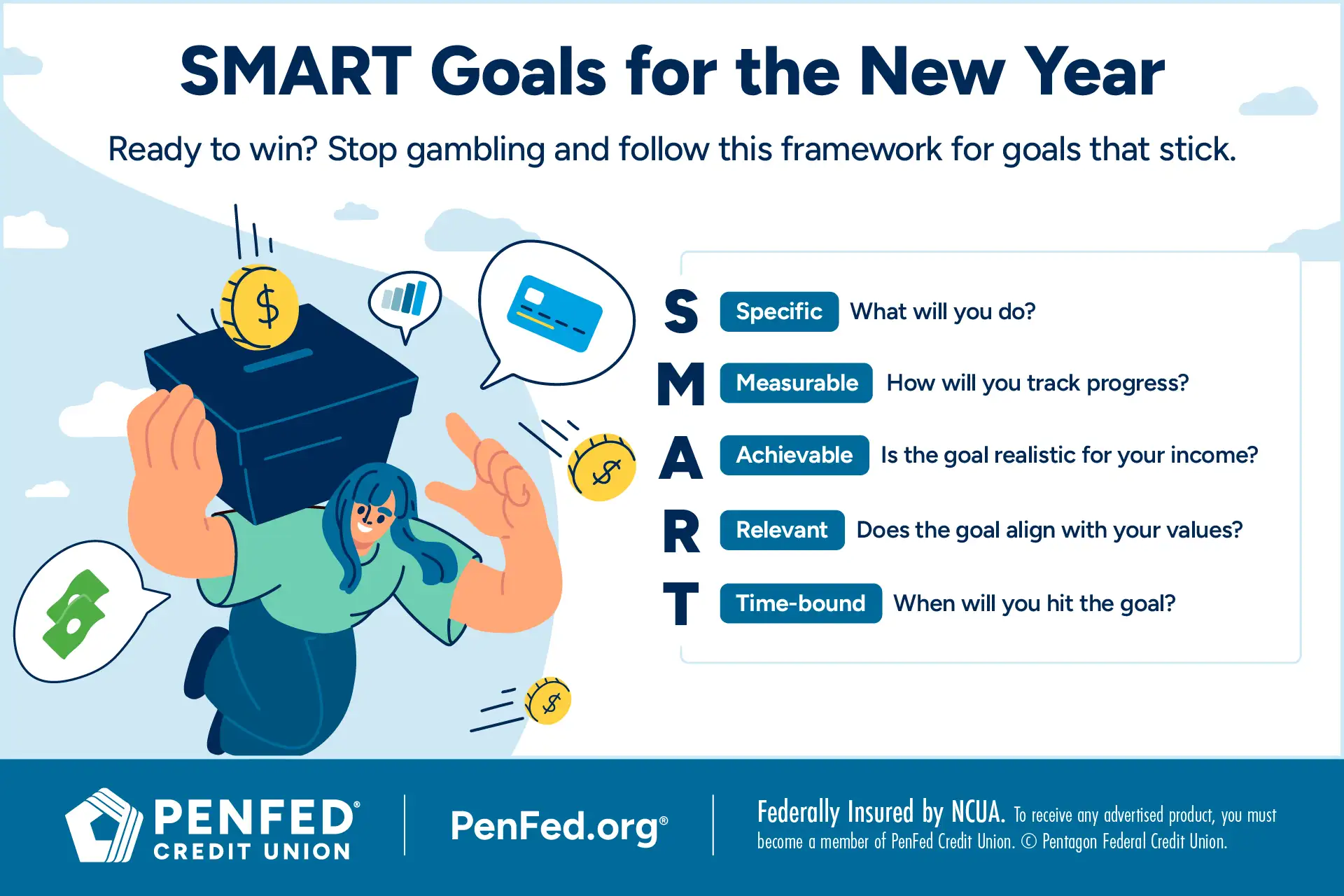
Let’s be real. A vague resolution like "I'll save more" might not go anywhere. Why? Because it gives you zero instructions. If you want real results, you need the SMART goal-setting framework. What is SMART? It’s a plan designed to help you chart your path to success by coming up with short- and long-term resolutions that are:
- Specific: What will you do?
- Measurable: How will you track progress?
- Achievable: Is the goal realistic for your income?
- Relevant: Does the goal align with your values?
- Time-bound: When will you hit the goal?
Think of it this way — saying "I want to be debt-free someday," is nice, but using the SMART method takes you from dreaming to doing.
SMART goal: "I will pay off my $3,000 credit card balance in the next 10 months by automating monthly payments of $300 + accrued interest."
See how that changes everything?
That sense of control is powerful, but looking at a year's worth of financial goals at once can feel overwhelming. So, let’s make it manageable.
The Three-Bucket Strategy
To keep your motivation up and momentum going, sort your goals into three buckets based on these targets: immediate, mid-year, and end-of-year.
|
Bucket |
Timeline |
Example Goal |
|---|---|---|
|
Immediate |
1-3 months |
Pay off a $350 outstanding medical bill using extra cash from selling unused items online. |
|
Mid-Year |
4-6 months |
Save $1,000 for a summer trip by automatically transferring $250 into a travel fund on the 1st of each month. |
|
End-of-Year |
10-12 months |
Use tax refund to pay off one high-interest credit card, reducing my total debt by $2,000. |
You can use a table like the one above, a spreadsheet, or personal finance app to help you stay on top of your money moves. Digital apps link to your accounts, automatically categorize your spending, and send instant alerts — just the convenience you need.
Know what to do, when to do it, and celebrate the small victories along the way! Check out our month-by-month financial guide for more tips.

How to Find Your ‘Why’ and Set Benchmarks
Before you commit to a plan:
- Take stock of your now: What’s your total take-home pay? What are your fixed expenses? How much debt do you carry? Knowing these numbers takes you from ground zero to winning strategy.
- Find the thing that keeps you going: If you’re saving for a down payment on a house, your "why" might be the joy of hosting loved ones in the dream kitchen you designed or having a big enough space to watch your family grow. Whatever the reason, write it down and keep it visible. It’s the difference between a goal that would be nice to reach and the financially stable future you’re driven to create.
- Define non-negotiables: Your plan must be sustainable. If your non-negotiable is paying for weekly childcare or a special hobby, build it into your budget. More on developing a plan you won’t abandon next.
Build a Realistic Budget
The problem with many budgets? They feel like a straitjacket.
A livable budget strategy allows you to balance your needs vs wants while routing the rest to your major financial goals. It also forces you to consider opportunity costs — is that takeout worth delaying your savings goal?
Which Type of Budget Is Right for Me?
The key is finding a system that requires the least amount of effort and yields the most impact. Here are two of our favorites:
- The zero-based budget
- The percentage-based budget
The Zero-Based Budget
With zero-based budgeting, you assign every single dollar of your paycheck a "job." Income minus expenses should always equal zero. Think of it like a puzzle — you don't stop until all the pieces (savings, debt payments, groceries, fun money) are accounted for.
Why it works: It eliminates "phantom money" (cash you forget about).
The Percentage-Based Budget
This is the budget for big-picture people who may not enjoy tracking every coffee run or car refuel. Percentage-based budgets, like the 50/30/20 and 70/20/10 rules, allocate a percentage of your after-tax income to broad categories.
Budgeting Rule Breakdown: Find Your Fit
|
Rule |
Allocation Breakdown |
The Upside |
The Downside |
|---|---|---|---|
|
50/30/20 |
50% needs |
Simple to implement, widely used |
Hard to maintain in HCOL areas where needs may exceed 50% |
|
70/20/10 |
70% living expenses and nonessentials |
May provide some flexibility for people in HCOL areas |
Does not separate essentials and nonessentials |
Pro tip: No matter the budget system you choose, commit to increasing your savings percentage by just 1% for the next three months. If you currently save 10% of your income, try saving 11%. This micro-adjustment is barely noticeable but builds momentum!
Dial Down Debt
Budgets are a must but so is crushing high-interest debt. In fact, debt payoff is the top financial New Year’s resolution for Americans followed by saving for major milestones and increasing their income. They know that little to no interest equals savings.
Debt Snowball vs. Debt Avalanche
Check out these two powerful strategies. The best one for you is the one you’ll stick to. And remember that the quickest way to pay down your debt is to avoid making any more charges on your credit cards during the payoff period.
|
Method |
How It Works |
Why It Works |
|---|---|---|
|
Debt Snowball |
Pay off debts starting with the smallest balance |
Experience quick wins as small accounts hit $0, motivating you to tackle bigger balances |
|
Debt Avalanche |
Pay off debts starting with the highest interest rate |
Save the most money over time by cutting down the most expensive interest charges |
Now, here’s how they work in the real world.
Let’s say you’ve budgeted $350 per month for debt payoff. You want to be done with your $3,500 debt, which is split across three accounts:
|
Account |
Balance |
Interest Rate |
Minimum Payment |
|---|---|---|---|
|
Credit card 1 |
$800 |
20% |
$35 |
|
Credit card 2 |
$1,500 |
25% |
$50 |
|
Personal loan |
$1,200 |
8% |
$40 |
|
Total |
$3,500 |
|
$125 |
Path 1: The Debt Snowball
You ignore the interest rates and focus on the lowest balance: credit card 1.
- You pay the minimum on the other two debts ($50 + $40 = $90).
- You put the remainder ($350 − $90 = $260) into credit card 1.
- The outcome: You pay off credit card 1 in 4 months, with a payment of less than $260 in the 4th month. You’re energized by the quick win. Now, continue to make the minimum payment of $50 on credit card 2, while putting the rest ($350 - $50 = $300) each month toward the next smallest debt — your personal loan.
Here’s how we did the math:
We entered the following into Bankrate’s Debt Payoff Calculator:
Balance: $800
Interest rate: 20%
Payment: $260
The results:
Number of months to payoff = 4
Total principal plus interest: $800 + $28 = $828
Total paid over months 1 through 3: $260 × 3 = $780
Total left to pay in month 4: $828 – $780 = $48
Path 2: The Debt Avalanche
You focus strictly on the highest interest rate: credit card 2.
- You pay the minimum on the other two debts ($35 + $40 = $75).
- You put the remainder ($350 − $75 = $275) into credit card 2.
- The outcome: You pay off credit card 2 in 6 months, while paying $109 in interest. To get this, we again used Bankrate’s Debt Payoff Calculator, with a balance of $1,500, interest rate of 25%, and monthly payment of $275. If you were to instead only make the minimum payment of $50, it would take you 48 months, and you would end up paying approximately $878 in interest!
Managing debt is doable, and using your extra cash to pay down your debt really makes a difference in how much interest you pay in the long run.
Pro Tip: Spend 30 minutes each month reviewing your bank and credit card statements.
3 Tips to Improve and Maintain Your Credit Score
Paid-off debt is great, but there’s more you can do for your credit score. Follow these rules:
- Automate every payment: The single biggest threat to your score is a missed payment. Set up autopay for all minimums so you don’t forget and wipe out months of hard work.
- Keep your utilization low: Your credit utilization (how much you owe versus your total borrowing limit) is the second most important factor in your credit score after payment history. Keep your balance below 30% of your limit — and aim for 10% for an even better score.
- Schedule check-ins: Spend 30 minutes each month reviewing your bank and credit card statements. Get free copies of your credit report. Plus, sign up for free credit-monitoring alerts offered by your bank, credit union, or a third-party service. This is how you’ll spot any errors or potential identity theft.
Start and Grow Your Safety Net
You hope you never need an emergency fund, but you’ll be grateful to have one when you do. Whether it’s a sudden job loss, an emergency vet visit, or a water heater repair, an emergency fund is the peace of mind you need when life’s curveballs hit, keeping you out of deep debt.
How Do I Find My Emergency Fund Number?
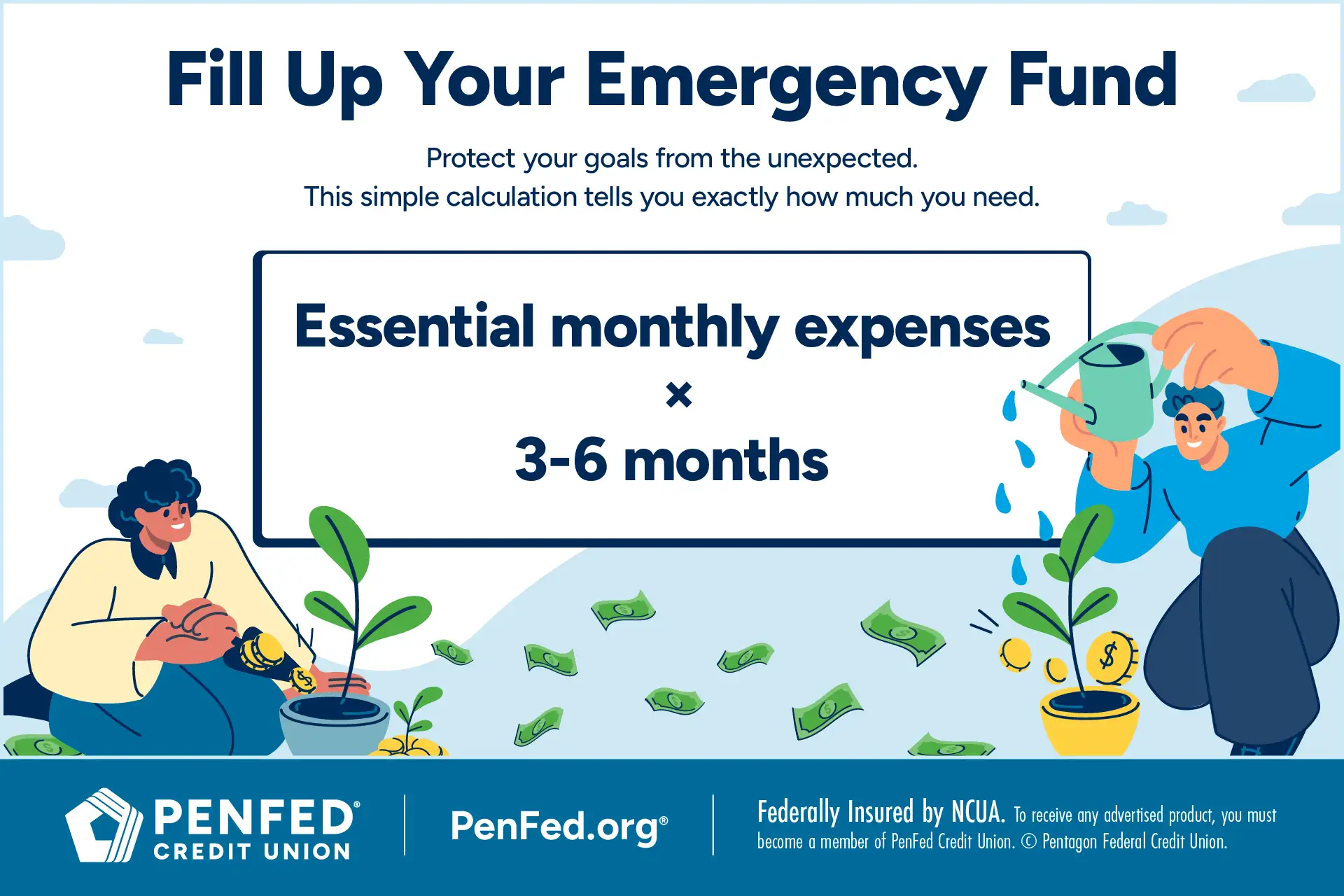
All you need is this simple formula:
Essential Monthly Expenses × 6 Months = Fully Funded Emergency Fund
Essential expenses are your non-negotiables — rent, utilities, groceries, gas, your phone bill, and minimum debt payments.
While a six-month safety net is the goal, aiming for three months is still a good target, especially if you're just starting out or have a low-overhead lifestyle. Does that still sound daunting? Maybe it’s because your main source of income is a bit shaky right now. Don’t worry, we’ve got you covered. Here are our top tips for managing a volatile income year-round.
Where Should I Keep My Emergency Fund?
The money in your emergency fund needs to be safe, separate, and working for you. A basic checking account makes it too easy to spend and keeping it under your mattress won’t pay interest.
The perfect home is a high-yield savings account (HYSA). Here are the perks:
- Higher interest: Your money grows faster than in a traditional savings account.
- Liquid and secure: It's easily accessible when you need it and federally insured.
Forget the suits and the stock market lingo — investing is how you’ll build wealth in 2026 and it doesn’t have to be complicated.
How to Invest in 2026: Micro Moves for Any Budget
Forget the suits and the stock market lingo — investing is how you’ll build wealth in 2026 and it doesn’t have to be complicated. It’s all about putting your money to work for you.
Steps to Start Investing
- Open an account: If your employer offers a 401(k) match, contribute enough to get the full match. That is an immediate, guaranteed return — you're leaving free money on the table if you don't! No match? Open a Roth IRA.
- Decide on an amount: Dedicate a small amount, like $25 per month (about as much as you’d spend buying lunch). See? It’s painless.
- Set it and forget it: Set up an automatic transfer for the day after your paycheck hits. If you never see the money, you won't miss it.
- Review and adjust your portfolio. Automating transfers doesn’t mean it’s okay to ignore your portfolio. Schedule quarterly or yearly check-ins or pop in when you get a raise. If you get a 3% raise, aim to increase your investment contribution by at least 1%. That small bump, multiplied over decades, makes a huge difference. And as you edge closer to retirement, you may consider moving more of your money into less volatile investments.
Keep at these steps and you’ll experience the magic of compounding.
Types of Investments
Some investments are easily accessible, while others require specialized knowledge or more money to be truly profitable. Investments also vary by how much risk they carry. Which investments best fit your strategy? Here’s a general breakdown to help you figure it out and diversify as needed.
|
Type of Investment |
Yield |
Difficulty |
Risk |
Cost to Start Investing |
Liquidity |
|---|---|---|---|---|---|
|
High-yield savings |
Low |
Low |
None |
Very low |
Highly liquid |
|
Bonds and bond index funds |
Low |
Low |
None |
Low |
Illiquid |
|
Dividend stocks |
Very low to very high |
Medium to high |
High |
Medium to high |
Highly liquid |
|
Dividend index funds and exchange-traded funds (ETFS) |
Low to high |
Low |
Low |
Low to medium |
Highly liquid |
|
Real estate |
Low to very high |
Medium to high |
Medium |
Low to high |
Highly liquid |
How Can I Keep My Resolutions Real — and Fun?
If your plan feels like homework, you'll burn out and ditch it. People who take their resolutions to the finish line turn them into routines they actually enjoy.
Mix in Motivation and Celebration
Here are four ways to get a dopamine hit when managing your money:
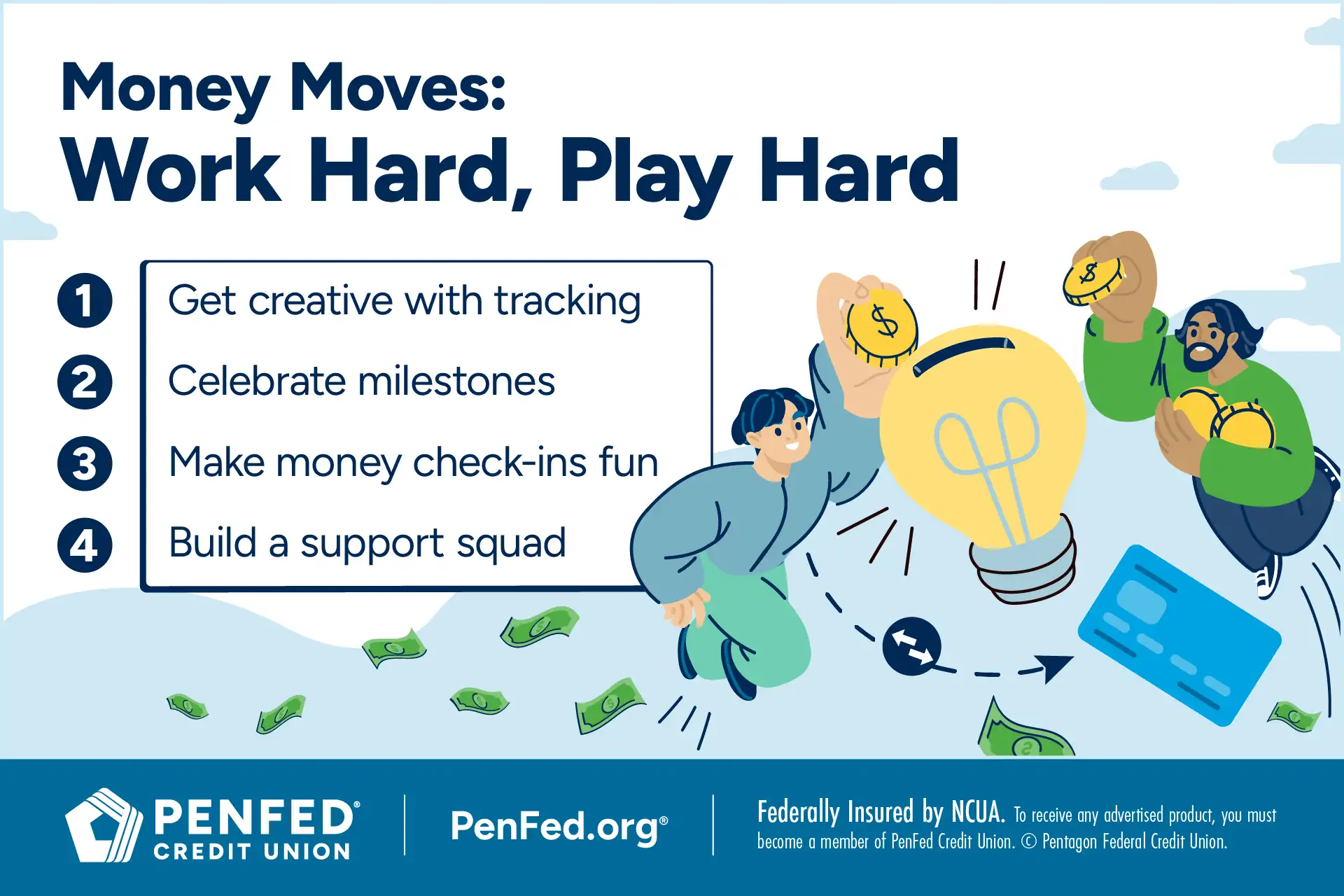
- Refine the aesthetics: Don't just look at a spreadsheet. Get creative with tracking! Intertwine colors with goals and affirmations. Example: Draw 100 squares on a poster, each representing $10 saved. Color in a square every time you hit the $10 milestone.
- Enjoy milestone rewards: When you reach a big goal, like paying off a credit card or filling your emergency fund halfway, plan a small, debt-free reward. It goes without saying, but the reward shouldn't cost as much as the amount you saved. Maybe it’s a nice dinner out or a massage.
- Take money date nights to the next level: Turn your financial review into a relaxing ritual. Brew your favorite coffee or tea, put on some music, and spend 30 minutes with your numbers. Don't stress it!
- Create a "money moves" group chat: Maintaining a healthy habit is much easier when you're not doing it alone. Gather friends or family with similar goals and get a text thread going. Meet once a month (virtually or in person) to share challenges, swap success stories, and keep each other accountable. And don’t forget to mix the serious with some fun — let those money memes and GIFs flow freely.
People who take their resolutions to the finish line turn them into routines they actually enjoy.
Yes! In fact, you could say yearly resolutions are baked in to being human. The first recorded New Year’s resolutions date back to ancient Babylon, nearly 4,000 years ago, so it’s safe to say that people will be making them for years to come.
The best way to record your promises for the new year is to write them by hand using pen and paper. When it comes to memory and learning, the act of writing something by hand blows typing out of the water. We suggest writing your resolutions on the first page of a pocket-sized notebook you can take everywhere. When you need a reminder, just pull out your notebook. Bonus points if you use the same notebook to track your progress!
The number one rule of budgeting is: be realistic. Create a budget that acknowledges where you’re at and what you value, rather than what society or someone else says you should value. The goal of a budget is to be sustainable, and you won’t keep to it if it doesn’t reflect who you really are. Your financial life is not about fitting in, it’s about fitting you.
Some common financial goals are: saving for a house, creating a college fund, saving for retirement, paying off debt, and sticking to a budget. Often, yearly financial goals serve these longer-term goals by tackling foundational milestones. If your goal is to save for retirement, your New Year’s resolution in 2026 might be to research all the ways you could save and find the retirement path that fits your lifestyle and values. Then, in 2027, you might resolve to put a certain amount of money into the path you decided on and planned out last year.
The Takeaway
Your game plan is in place, and now you have the tools to start and end strong. Embrace simple habits, stay consistent even when progress feels slow, pivot when the numbers say so, infuse fun, and trust the process.
Selected Sources:
Credit Card Payoff Calculator | Bankrate
Survey: Optimism Grows About Keeping Financial New Year's Resolutions in 2025 | The Motley Fool
Sources last accessed October 2025
Ready to Take Control of Your Money?
Get effortless, round-the-clock banking with a PenFed checking account.