Skip to Main Content
Log In Accounts
Checking & Savings
Checking iconChecking
All Checking Accounts
Free Checking
Access America Checking

Grow your everyday cash

Savings iconSavings
All Savings Accounts
Premium Online Savings

Save more, earn more

Regular Savings
Certificates iconCertificates
All Certificates
Money Market Certificate

Great rates, guaranteed returns

IRA IconRetirement
All Retirement
IRA Certificate

Locked-in retirement growth

IRA Savings

Secure retirement savings


Credit Cards
Credit card iconCredit Cards
All Credit Cards
PenFed Power Cash Rewards® Visa Signature®

Unlimited cash back

PenFed Pathfinder® Rewards Visa Signature®

Travel points and perks

PenFed Platinum Rewards Visa Signature®

Earn on gas, groceries & more

PenFed Gold Visa®

Save on interest

Learn more resources iconLearn More
Resource Center
Featured Articles
Disclosures
Contact Credit Cards

Card support and management


Autos
Auto loans iconAuto Loans
Purchase
Refinance
Car Buying Service

Powered by TrueCar

Shield iconProtection
Vehicle Protection
GAP Coverage
Debt Protection
Learn more resources iconLearn More
Featured Articles
Autos FAQ
Autos Form

Homes
call expert icon

Talk to a Home Loan Advisor

Available

Mon-Fri: 8 am - 8 pm ET
Sat: 9 am - 5 pm ET

Call Now
Buy a home iconBuy a Home
Get Started
Why PenFed Home
Find Your Home
Get Pre-Approved
Refinance loan iconRefinance Your Loan
Start Your Refinance
Refinance Calculator
Home equity iconUnlock Your Equity
HELOC

Home Equity Line of Credit

Cash-Out Refinance
Sell Your Home
Resources iconRates & Resources
Current Rates
Learning Center

Articles about mortgage, home equity, and more

Contact Home Team

Make an inquiry, discuss existing loans, and more

Mortgage Calculator

Loans
Loans iconPersonal Loans
All Personal Loans
Debt Consolidation
Home Improvement
Personal Use
Student loans iconStudent Loans
Student Loans
Learn more resources iconLearn More
Featured Articles
Loans FAQs
Loans Forms

Resources
Learning hub iconLearning Hub
Learning Center
Mortgage Knowledge Center
Security lock iconSecurity & Fraud
Security Center
Fraud Prevention
Information iconAssistance
Foundation

Empowering veteran transition

Financial Assistance Center

Relief options and financial assistance

Natural Disaster Assistance

Emergency relief assistance

Learn more resources iconHelpful Links
Wealth Management

Financial advice tailored for you

New Members
Member Discounts

About
Penfed logoAbout PenFed
About Us
Sponsors
Partners
Careers
Foundation

Empowering veteran transition

Contact Us

Log In Accounts Join Today
  • Contact Us
  • FAQs
  • Forms
  • ATMs & Branches
Routing #256078446
Copied to clipboard
Checking icon Checking
All Checking Accounts
Free Checking
Access America Checking

Grow your everyday cash

Savings icon Savings
All Savings Accounts
Premium Online Savings

Save more, earn more

Regular Savings
Certificates icon Certificates
All Certificates
Money Market Certificate

Great rates, guaranteed returns

IRA Icon Retirement
All Retirement
IRA Certificate

Locked-in retirement growth

IRA Savings

Secure retirement savings

Contact Us
FAQs
Forms
ATMs & Branches
Routing #256078446
background-promo
Deposit cash where you shop
checking global nav

Add funds to your account at participating retailers nationwide.

Learn More

Credit card icon Credit Cards
All Credit Cards
PenFed Power Cash Rewards® Visa Signature®

Unlimited cash back

PenFed Pathfinder® Rewards Visa Signature®

Travel points and perks

PenFed Platinum Rewards Visa Signature®

Earn on gas, groceries & more

PenFed Gold Visa®

Save on interest

Learn more resources icon Learn More
Resource Center
Featured Articles
Disclosures
Contact Credit Cards

Card support and management

Contact Us
FAQs
Forms
ATMs & Branches
Routing #256078446
background-promo
Enjoy unlimited cash back with no caps or restrictions!
credit cards global nav

Earn more on every purchase with a PenFed cash back card.

Learn More

Auto loans icon Auto Loans
Purchase
Refinance
Car Buying Service

Powered by TrueCar

Shield icon Protection
Vehicle Protection
GAP Coverage
Debt Protection
Learn more resources icon Learn More
Featured Articles
Autos FAQ
Autos Form
Contact Us
FAQs
Forms
ATMs & Branches
Routing #256078446
background-promo
Park Yourself Here
auto loans

PenFed Auto is your ultimate destination to shop, finance and own your vehicle.

Learn More

background-promo
call expert icon

Talk to a Home Loan Advisor

Available

800-970-7766

Mon-Fri: 8 am - 8 pm ET
Sat: 9 am - 5 pm ET

Buy a home icon Buy a Home
Get Started
Why PenFed Home
Find Your Home
Get Pre-Approved
Refinance loan icon Refinance Your Loan
Start Your Refinance
Refinance Calculator
Home equity icon Unlock Your Equity
HELOC

Home Equity Line of Credit

Cash-Out Refinance
Sell Your Home
Resources icon Rates & Resources
Current Rates
Learning Center

Articles about mortgage, home equity, and more

Contact Home Team

Make an inquiry, discuss existing loans, and more

Mortgage Calculator
Contact Us
FAQs
Forms
ATMs & Branches
Routing #256078446
Loans icon Personal Loans
All Personal Loans
Debt Consolidation
Home Improvement
Personal Use
Student loans icon Student Loans
Student Loans
Learn more resources icon Learn More
Featured Articles
Loans FAQs
Loans Forms
Contact Us
FAQs
Forms
ATMs & Branches
Routing #256078446
background-promo
Personal Loans made easy
personal loan

From home repairs to dream trips, PenFed makes it happen.

Learn More

Learning hub icon Learning Hub
Learning Center
Mortgage Knowledge Center
Security lock icon Security & Fraud
Security Center
Fraud Prevention
Information icon Assistance
Foundation

Empowering veteran transition

Financial Assistance Center

Relief options and financial assistance

Natural Disaster Assistance

Emergency relief assistance

Learn more resources icon Helpful Links
Wealth Management

Financial advice tailored for you

New Members
Member Discounts
Contact Us
FAQs
Forms
ATMs & Branches
Routing #256078446
background-promo
Wealth built for you
wealth management global nav

Life throws a lot your way. Let PenFed Wealth Management be your partner in building a secure financial future.

Learn More

Penfed logo About PenFed
About Us
Sponsors
Partners
Careers
Foundation

Empowering veteran transition

Contact Us
Join Today
Popular Searches:
PenFed Routing #256078446
Check status of my loan application...
Security Center
Log In Accounts

LEARNING CENTER

To get ahead you have to stay informed.
  1. Home
  2. Learning Center
  3. How Much Credit Card Debt Is Too Much? | PenFed Credit Union

CREDIT CARDS

How Much Credit Card Debt Is Too Much?

EXPECTED READ TIME:6 minutes

Published: February 4, 2022

The answer depends on your financial situation. And while there’s no magic number, there are some formulas that will help you understand how lenders view your debt. By considering your income, lifestyle, and total available credit, you can decide what amount of credit card debt you’re comfortable with.
What We’ll Cover

  • 6 Signs You Have Too Much Credit Card Debt
  • How Much Credit Card Debt Does the Average American Have?
  • How to Handle Too Much Credit Card Debt
credit-card-debt

6 Signs You Have Too Much Credit Card Debt

Credit card debt isn’t always a bad thing. It can help you spread out payments, manage cash flow, and earn cash back or reward points. When chosen wisely and used judiciously, credit cards can build your credit by establishing a long, reliable payment history.

Credit Card Icon

Learn how a credit card can help you build credit. 

Read More

But credit cards are revolving debt, meaning that you’re constantly in a cycle of paying them down and then adding to them again. Along with high interest (compared to other types of loans), this kind of debt has a habit of getting away from you.

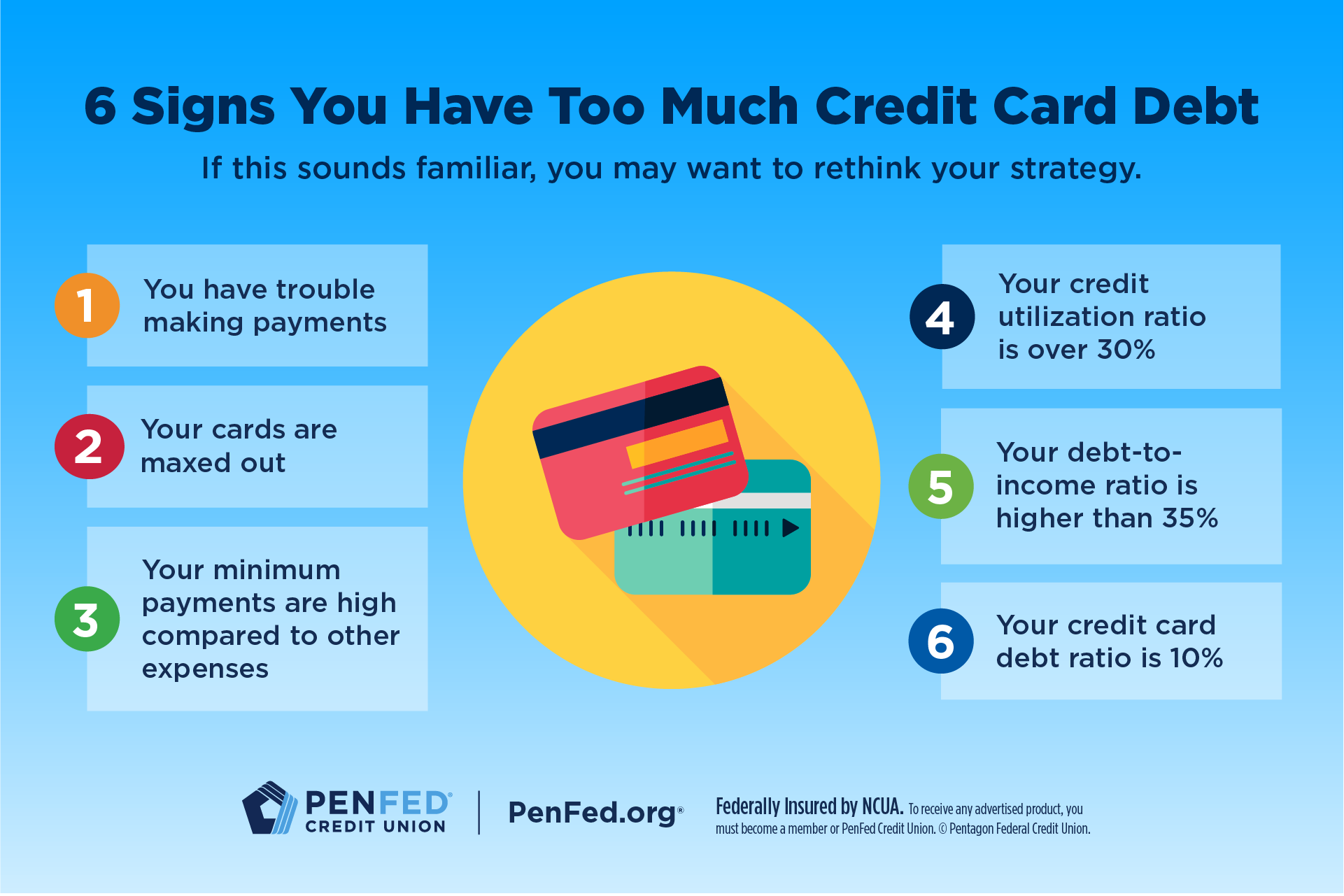
Here are six indicators that you have too much credit card debt:

You Have Trouble Making Payments

You might have too much credit card debt if you’re struggling to afford more than minimum payments. Minimum monthly payments for most credit cards only cover interest, fees, and a fraction of your actual balance. If you’re not paying more, then your balance is growing — and may become difficult to pay off.

Using one credit card to pay off others is another sign that you have too much credit card debt. Moving your debt around like this doesn’t resolve the problem and may cost you more in the long term.

Evaluating your credit card debt is a healthy part of financial wellness.

Your Cards Are Maxed Out

If you’re regularly reaching your credit limit on your credit cards, this may indicate a problem. Carrying a high balance could indicate you’re overspending and that reflects badly on your credit score.

You Have High Card Payments

One easy way to evaluate your credit card debt is to compare it to your other bills. If your total payments on all of your credit cards is close to what you pay for non-discretionary expenses like your rent, mortgage, or auto loans then you’re likely carrying too much credit card debt.

Your Credit Utilization Ratio Is High

Credit utilization is a way of measuring how much of your available credit you are using. Anything over 30% credit utilization is considered high and will hurt your credit score — and that goes for your debt per card as well as your total debt overall.

Lower credit utilization is more favorable. In fact, credit utilization is the second biggest factor affecting your credit score. It shows you manage your credit wisely without relying on it to get by.

Credit utilization is the second biggest factor affecting your credit score.

How To Calculate Credit Utilization

To find your credit utilization, add up the total amount you owe on your credit cards and divide that number by your credit limit.

For instance, if you have three credit cards and each has a credit limit of $3,000, then your total available credit is $9,000. Let’s say you owe the following:

  • $500 on Card A
  • $500 on Card B
  • $1,000 on Card C

Your total combined debt is $2,000. If we divide that by your available credit then we get 0.22 — meaning you’re using just under a quarter of your available credit.

Total Combined Debt / Available Credit = Credit Utilization  

Ideally, the credit utilization on cards A, B, and C will be under 30% per card, and your overall credit utilization will also be under 30%. In the example above, your overall credit utilization is good at 22%, but Card C is hovering just above the 30% mark. That’s the balance you’ll want to focus on paying down first.

percent

Find out everything you need to know about credit utilization with our guide.

Learn More

You Have a High Debt-to-Income Ratio

Your debt-to-income ratio is another way to put your credit card debt in context. This ratio compares your total monthly expenses to your monthly pre-tax income. To calculate it, add up all of your monthly bills such as:

  • Rent or mortgage
  • Auto loans
  • Student loans
  • Credit cards
  • Any other debt you carry

A lower debt-to-income ratio tells lenders you’re more likely to repay what you borrow. Debt-to-income ratios of 35% or less are considered good.


You might have too much credit card debt if you’re struggling to afford more than minimum payments.

How to Calculate Debt-to-Income

Let’s say you’re calculating your debt-to-income ratio. Your monthly pre-tax income is $5,000 and you have the following monthly expenses:

  • Mortgage: $1,200
  • Car loan: $500
  • Credit cards: $300

Your total monthly expenses are $2,000. Divide that by your gross monthly income and you end up with a debt-to-income ratio of 40%.

To manage your debt better, apply for a credit card balance transfer to a card with a lower interest rate.

Limits of Debt-to-Income Ratio

One downside of the debt-to-income ratio is that this ratio accounts for your total debt rather than your credit card debt alone. Many financial experts agree that some debts are “healthier” than credit card debt. For instance, your mortgage or students loans:

  • Don’t charge the same interest as a credit card
  • Are paid in a set number of installments
  • Are less likely to get out of control
  • May be partially written off your federal income taxes

While debt-to-income ratio is still a useful tool for evaluating your finances, you’ll get a better sense of how your credit card debt impacts you if you pair it with other evaluative tools.  

Credit card payments shouldn’t exceed 10% of your net income.

Credit Card Debt Ratio

A simpler way of evaluating your credit card debt is through your credit card debt ratio. This ratio looks at how much after-tax income you have each month to cover your credit card debt. If your minimum credit card payments are too high, they’ll make it hard to cover your other expenses. Credit card payments shouldn’t exceed 10% of your net income.

Imagine your monthly net income is $4,000 and you have the following minimum payments due on credit cards:

  • $75 on Card A
  • $120 on Card B
  • $50 on Card C

That gives you a total minimum credit card debt of $245 monthly. Dividing by your net monthly incomes shows you have a credit card debt ratio of 6%.

How Much Credit Card Debt Does the Average American Have?

According to a recent study by Experian, the average American carries a credit card balance of $5,315. That’s not an easy sum for most people to pay off quickly, which means most Americans are carrying their balance for a while.

One alternative is a personal line of credit. Known as a PLOC, it’s similar to a credit card in that it’s a revolving line of credit, but a PLOC is only available during a set timeframe and usually comes with a lower interest rate. You’ll draw from it by writing checks instead of swiping a card.

A typical PLOC is available for between six months and five years and provides a credit limit of between $1,000 and $100,000. Most have a monthly repayment schedule.

PLOCs are great for small home remodels, medical expenses, or refinancing loans. Some borrowers also use them to reconsolidate credit card debt.

Personal lines of credit are great for small home remodels, medical expenses, or refinancing loans.

How to Handle Too Much Credit Card Debt

The first step is to evaluate the problem. If you’re overspending, then it’s time to create a budget and stick to it. This may require cutting unnecessary expenses or creating a schedule of your monthly bills so you avoid costly late fees.

Paying more than the minimum monthly payment is also important. If you’ve only been paying the minimums, then you’ll need to adjust your spending so you can increase your monthly payments. Otherwise, you’re only treading water and not making real progress.

Many financial experts agree that some debts are “healthier” than credit card debt.

For many people with high credit card debt, month-to-month payments are simply too high for them to ever pay down the principle. If this sound familiar, you can try a couple of things to make payments more manageable:

  • Find additional income such as a part-time job
  • Call your credit card lender and ask for a lower interest rate
  • Apply for a credit card balance transfer to a card with a lower interest rate or 0% introductory rate
  • Consolidate your credit card debt with a type of personal loan called a debt consolidation loan

The Takeaway

Evaluating your credit card debt is a healthy part of financial wellness. By examining your credit card debt in relation to your other finances, you can learn to leverage your credit more effectively, cut expenses, and establish strategies for paying off debt to build a better financial future.

Eliminate Credit Card Debt For Good

Learn a few simple strategies for paying off your cards.

Learn More

SIMILAR ARTICLES

5 Reasons to Use a Personal Loan for Debt Consolidation

Taking out a personal loan to pay off credit cards and other high-interest debt could simplify your personal finances and save you thousands.

using personal loan for debt consolidation

How Credit Cards and Credit Card Interest Actually Work

Understanding how credit cards work and the way interest is calculated can make you a more informed shopper and a better manager of credit.

using credit card

How and When to Dispute a Credit Card Charge

If you had to dispute a charge on your credit card, would you know how? Read on to learn how and when you should dispute a credit card charge.

disputing credit card charge

Best Security Practices for Credit Cardholders

Getting a credit card comes with a lot of responsibility. Here are some best security practices for credit cardholders to make sure you are keeping yourself safe.

security and credit cards
  • ATMs & Branches
  • Careers
  • Foundation
  • Contact Us
  • Security Center

This credit union is federally insured by the National Credit Union Administration. Rates are current as of June 2026 unless otherwise noted and are subject to change.

APY = Annual Percentage Yield
APR = Annual Percentage Rate


  • facebook
  • twitter
  • linkedin
  • youtube
  • instagram
Download the PenFed app on Apple Store Download the PenFed app on Google Play
Read More about Equal Housing
Routing #256078446

©2026 Pentagon Federal Credit Union

Privacy
Disclosures
Fees
Rates
Forms
Site Map
Hands on laptop

We value your feedback!

Head’s Up!

You are about to visit a third-party site not affiliated with PenFed.org.

penfedcu.sparrowfi.com sparrowfi.com penfed and traveller logo penfed and seguros logo penfed and national car logo penfed and trustage logo PenFed and CampusDoor logo PenFed and Ascent logo PenFed and Ascent logo penfed and househappy logo penfed and benefit services logo penfed and chubb logo penfed and alpha logo penfed and crutchfield logo penfed and ftd logo1

This content is from a third-party website. PenFed Credit Union is not responsible for its information.

Continue