Skip to Main Content
Log In Accounts
Checking & Savings
Checking iconChecking
All Checking Accounts
Free Checking
Access America Checking

Grow your everyday cash

Savings iconSavings
All Savings Accounts
Premium Online Savings

Save more, earn more

Regular Savings
Certificates iconCertificates
All Certificates
Money Market Certificate

Great rates, guaranteed returns

IRA IconRetirement
All Retirement
IRA Certificate

Locked-in retirement growth

IRA Savings

Secure retirement savings


Credit Cards
Credit card iconCredit Cards
All Credit Cards
PenFed Power Cash Rewards® Visa Signature®

Unlimited cash back

PenFed Pathfinder® Rewards Visa Signature®

Travel points and perks

PenFed Platinum Rewards Visa Signature®

Earn on gas, groceries & more

PenFed Gold Visa®

Save on interest

Learn more resources iconLearn More
Resource Center
Featured Articles
Disclosures
Contact Credit Cards

Card support and management


Autos
Auto loans iconAuto Loans
Purchase
Refinance
Car Buying Service

Powered by TrueCar

Shield iconProtection
Vehicle Protection
GAP Coverage
Debt Protection
Learn more resources iconLearn More
Featured Articles
Autos FAQ
Autos Form
Resource Center

Homes
call expert icon

Talk to a Home Loan Advisor

Available

Mon-Fri: 8 am - 8 pm ET
Sat: 9 am - 5 pm ET

Call Now
Buy a home iconBuy a Home
Get Started
Why PenFed Home
Find Your Home
Get Pre-Approved
Refinance loan iconRefinance Your Loan
Start Your Refinance
Refinance Calculator
Home equity iconUnlock Your Equity
HELOC

Home Equity Line of Credit

Cash-Out Refinance
Sell Your Home
Resources iconRates & Resources
Current Rates
Learning Center

Articles about mortgage, home equity, and more

Contact Home Team

Make an inquiry, discuss existing loans, and more

Mortgage Calculator

Loans
Loans iconPersonal Loans
All Personal Loans
Debt Consolidation
Home Improvement
Personal Use
Student loans iconStudent Loans
Student Loans
Learn more resources iconLearn More
Featured Articles
Loans FAQs
Loans Forms

Resources
Learning hub iconLearning Hub
Learning Center
Mortgage Knowledge Center
Security lock iconSecurity & Fraud
Security Center
Fraud Prevention
Information iconAssistance
Foundation

Empowering veteran transition

Financial Assistance Center

Relief options and financial assistance

Natural Disaster Assistance

Emergency relief assistance

Learn more resources iconHelpful Links
Wealth Management

Financial advice tailored for you

New Members
Member Discounts

About
Penfed logoAbout PenFed
About Us
Sponsors
Partners
Careers
Foundation

Empowering veteran transition

Contact Us

Log In Accounts Join Today
  • Contact Us
  • FAQs
  • Forms
  • ATMs & Branches
Routing #256078446
Copied to clipboard
Checking icon Checking
All Checking Accounts
Free Checking
Access America Checking

Grow your everyday cash

Savings icon Savings
All Savings Accounts
Premium Online Savings

Save more, earn more

Regular Savings
Certificates icon Certificates
All Certificates
Money Market Certificate

Great rates, guaranteed returns

IRA Icon Retirement
All Retirement
IRA Certificate

Locked-in retirement growth

IRA Savings

Secure retirement savings

Contact Us
FAQs
Forms
ATMs & Branches
Routing #256078446
background-promo
Deposit cash where you shop
checking global nav

Add funds to your account at participating retailers nationwide.

Learn More

Credit card icon Credit Cards
All Credit Cards
PenFed Power Cash Rewards® Visa Signature®

Unlimited cash back

PenFed Pathfinder® Rewards Visa Signature®

Travel points and perks

PenFed Platinum Rewards Visa Signature®

Earn on gas, groceries & more

PenFed Gold Visa®

Save on interest

Learn more resources icon Learn More
Resource Center
Featured Articles
Disclosures
Contact Credit Cards

Card support and management

Contact Us
FAQs
Forms
ATMs & Branches
Routing #256078446
background-promo
Enjoy unlimited cash back with no caps or restrictions!
credit cards global nav

Earn more on every purchase with a PenFed cash back card.

Learn More

Auto loans icon Auto Loans
Purchase
Refinance
Car Buying Service

Powered by TrueCar

Shield icon Protection
Vehicle Protection
GAP Coverage
Debt Protection
Learn more resources icon Learn More
Featured Articles
Autos FAQ
Autos Form
Resource Center
Contact Us
FAQs
Forms
ATMs & Branches
Routing #256078446
background-promo
Park Yourself Here
auto loans

PenFed Auto is your ultimate destination to shop, finance and own your vehicle.

Learn More

background-promo
call expert icon

Talk to a Home Loan Advisor

Available

800-970-7766

Mon-Fri: 8 am - 8 pm ET
Sat: 9 am - 5 pm ET

Buy a home icon Buy a Home
Get Started
Why PenFed Home
Find Your Home
Get Pre-Approved
Refinance loan icon Refinance Your Loan
Start Your Refinance
Refinance Calculator
Home equity icon Unlock Your Equity
HELOC

Home Equity Line of Credit

Cash-Out Refinance
Sell Your Home
Resources icon Rates & Resources
Current Rates
Learning Center

Articles about mortgage, home equity, and more

Contact Home Team

Make an inquiry, discuss existing loans, and more

Mortgage Calculator
Contact Us
FAQs
Forms
ATMs & Branches
Routing #256078446
Loans icon Personal Loans
All Personal Loans
Debt Consolidation
Home Improvement
Personal Use
Student loans icon Student Loans
Student Loans
Learn more resources icon Learn More
Featured Articles
Loans FAQs
Loans Forms
Contact Us
FAQs
Forms
ATMs & Branches
Routing #256078446
background-promo
Personal Loans made easy
personal loan

From home repairs to dream trips, PenFed makes it happen.

Learn More

Learning hub icon Learning Hub
Learning Center
Mortgage Knowledge Center
Security lock icon Security & Fraud
Security Center
Fraud Prevention
Information icon Assistance
Foundation

Empowering veteran transition

Financial Assistance Center

Relief options and financial assistance

Natural Disaster Assistance

Emergency relief assistance

Learn more resources icon Helpful Links
Wealth Management

Financial advice tailored for you

New Members
Member Discounts
Contact Us
FAQs
Forms
ATMs & Branches
Routing #256078446
background-promo
Wealth built for you
wealth management global nav

Life throws a lot your way. Let PenFed Wealth Management be your partner in building a secure financial future.

Learn More

Penfed logo About PenFed
About Us
Sponsors
Partners
Careers
Foundation

Empowering veteran transition

Contact Us
Join Today
Popular Searches:
PenFed Routing #256078446
Check status of my loan application...
Security Center
Log In Accounts

LEARNING CENTER

To get ahead you have to stay informed.
  1. Home
  2. Learning Center
  3. How Long to Keep Financial Records

FINANCE

How Long to Keep Financial Records

EXPECTED READ TIME: 7 MINUTES

Published: May 6, 2022

If you’re anything like, well, just about everyone, you don’t give too much thought to when, why, or how you store financial records.

Your filing system may consist of several cardboard boxes stuffed with tax returns from years past and bank statements from who knows when shoved in a corner closet.

Here’s a quick guide to determining when to hold on to your personal financial records — and when to let them go.

What We'll Cover
  • What Are Personal Financial Records?
  • Timelines for Keeping Good Financial Records
  • How to Organize the Financial Records You Keep
Infographic_How-Long-to-Keep-Financial-Records

What Are Personal Financial Records?

Personal financial records are any type of documents, whether printed or electronic, related to your money and assets. This information commonly includes:

  • Paychecks and paystubs
  • Bank statements
  • Invoices and receipts
  • Deposit and withdrawal slips
  • W-2s and income tax returns
  • Mortgage and personal loan files
  • Investment documents
  • Insurance policies
icon certificate

Did you know your credit score and credit report are two different things? 

Learn More

Timelines for Keeping Good Financial Records

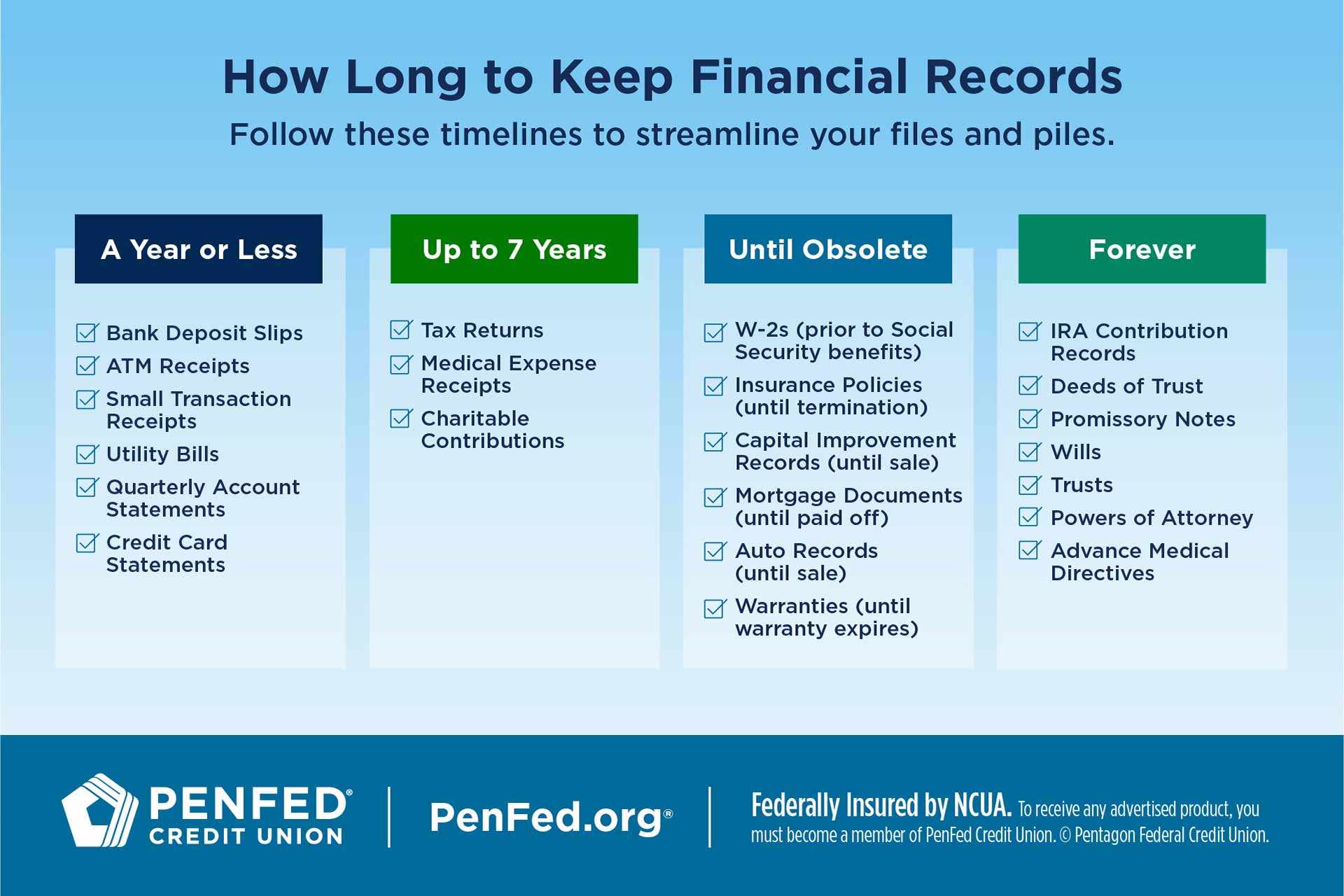
Although fear of an IRS audit may compel you to store any and all financial records for years on end, you really don’t need to save all of these documents indefinitely. Follow these timelines to streamline your files and piles.

Financial Records to Keep a Year or Less

To avoid becoming engulfed in pulp, you should purge a lot of financial paperwork within 12 months or less of when the purchase or account activity takes place. This includes:
  • Receipts for Small Transactions. Feel free to shred bank deposit slips, ATM receipts, and proofs of purchase for gas, groceries, and other everyday transactions once you’ve confirmed the amount charged to your debit or credit card is correct and you’re certain you won’t need the paperwork to return any of the items.
  • Utility Bills. Unless you need them for business-related deductions on your taxes, there’s no reason to let monthly bills for electricity, water, and phone service collect dust on your desk longer than three months. Just make sure each statement shows that your previous payment was received.
There’s no reason to let monthly bills for electricity, water, and phone service collect dust on your desk longer than three months.
  • Pay Stubs. Hold on to all of your pay stubs for the year until you receive your W-2 (or 1099 if you’re self-employed) so you can ensure the income and deduction totals from your checks match the numbers printed on your tax forms. You’ll also need three to five months of recent pay stubs on hand if you plan to apply for a loan.
  • Periodic Statements. For the most part, you can discard monthly and quarterly statements for your mortgage, investments, and checking and savings at the end of the year, provided the information on them jibes with annual summaries you receive for each account.
If the government suspects your income was under-reported by 25% or more, the IRS can slap you with an audit up to six years later.
  • Credit Card Statements. Since Uncle Sam doesn’t accept credit card statements as sufficient documentation for tax purposes, there’s no reason to keep paper copies more than a few months. Again, the main thing is to confirm all the charges correspond to your individual receipts and you have proof of your last payment.

Financial Records to Keep Up to Seven Years

Negative marks can stay on your credit report for up to seven years, which makes it a good idea to retain some financial records for the same amount of time. Another seven-year category includes any tax-related documents:
  • Tax Returns. You’ve probably heard that the IRS has three years from the date you file your tax return to conduct an audit. But did you know that this limit only applies to errors made in good faith?

If the government suspects your income was under-reported by 25% or more, the IRS can slap you with an audit up to six years later. So, to be safe, tuck away your tax records, as well as supporting receipts, documents, and worksheets, for at least seven years.

icon money

How does an IRA work? We’ll take you through the basics.

Learn More
  • Medical Expenses. Health insurance claims often generate scores of paperwork, even for simple procedures and routine exams. Regardless, you should keep premium statements, medical bills, and supporting documents for health care-related expenses for five years — seven if you need them to support an income tax deduction.
  • Charitable Contributions. Save receipts, acknowledgment letters, and other records detailing money or property that you donated to your church, United Way, Salvation Army, or any other charitable organizations for seven years. To make things easier, file this information with your income tax returns for the appropriate year.
W-2s are your best proof of earnings if you ever need to verify your benefit amount.

Financial Records to Keep Until Obsolete

As one chapter in your life closes, another opens. There are some documents that don’t carry an arbitrary expiration. Instead, they just become obsolete. These types of documents include:
  • W-2s. Make a point to retain your W-2 forms until you start receiving your Social Security benefits. They’re your best proof of earnings if you ever need to verify your benefit amount.
  • Insurance Policies. You can get rid of insurance policies as soon as the coverage expires, with one exception: occurrence policies. These records cover you for damages that happened during the time the policy was in place, even if the claim is made when you no longer have the coverage. Hold these documents permanently.
If a product or service you purchase comes with a warranty, hold on to the paperwork as long as you own or use it.
  • Capital Improvement Records. If you make substantial upgrades to your home, it’s best to keep any receipts, warranties, plans, and permits related to the materials used and work performed until you sell the home. Of course, if you take any income tax deductions on the project, you should retain the documents for at least seven years, even if you sell the property before that period is up. 
  • Mortgage Documents. Regardless of the length or type of mortgage you have, maintain copies of all documents for your home loan until it’s paid in full. Better still, store the records in a safe place for up to seven years after you settle the debt.
  • Automobile Records. Aside from a home, your car or truck is probably the most expensive purchase you’ll make. So, you’d do well to keep any paperwork for your vehicle — including service records and receipts — until you sell it, trade it in, or get rid of it some other way.
  • Warranties. If a product or service you purchase comes with a warranty, hold on to the paperwork as long as you own or use it. Select components may be guaranteed longer than others, and the documents often include contact numbers to help you track down repair companies and parts suppliers. 
Fingerprint icon

Learn what to do if your identity is stolen.

Read More

Financial Records to Keep Forever

Without context, the idea of “forever” can seem a little daunting, but it doesn’t have to be when it comes to your financial records. In fact, records that stay relevant throughout your life (and sometimes after) are often tied to positive achievements.
  • IRA Contributions. Although there’s no way to avoid paying taxes on your retirement savings, keeping records of your contributions will help to ensure you don’t overpay the government once you start taking money from your traditional IRA. (You can always convert your savings to a Roth IRA and enjoy tax-free withdrawals once you reach retirement.)
  • Proofs of Property Ownership. Few pieces of paper carry as much weight as deeds of trusts, promissory notes, and other records of ownership for homes, land, and property. These documents prove even more valuable in property disputes or if you find clerical errors when you’re selling property and other large assets.
When it’s time to get rid of financial records, shredding is the quickest, safest, and most effective way to dispose of the paperwork.
  • Final Legal Documents. As uncomfortable as it may be to think about and discuss, you need to set up and maintain wills, trusts, powers of attorney, and advance medical directives for you and your loved ones, particularly as you (or they) get older. These legal documents are crucial for designating properties and rights and honoring the deceased person’s final requests.
  • Personal Information. Even though birth certificates, Social Security cards, marriage certificates, and death certificates aren’t technically financial documents, they’re inextricably linked to your finances. These records can impact everything from getting a job and qualifying for loans to taking out insurance and administering death benefits.

How to Organize the Financial Records You Keep

Whether you’re saving financial records for a few days, a few years, or forever, you need to file them in a place that’s safe and easy to access. These pointers will help you manage your important documents for the short and long terms:
  • Shred old paperwork. It’s no longer enough to tear old paperwork and throw it into the trash can or recycling bin. Identity theft and fraud accounts for billions of dollars in damages each year, and old-fashioned dumpster diving remains one of the preferred methods crooks use to hijack the information they need.

When it’s time to get rid of financial records, shredding is the quickest, safest, and most effective way to dispose of the paperwork. The $50-100 you’ll spend for a paper shredder can potentially save you hundreds or thousands of dollars — and an immeasurable amount of headaches and stress— that you stand to lose if your Personally Identifiable Information (PII) winds up in the wrong hands.

Store financial documents you need to keep readily available in a safe, out-of-the-way place in your home.
  • File time-sensitive documents. Store financial documents you need to keep readily available in a safe, out-of-the-way place in your home. Ideally, you should arrange them alphabetically in individual folders by the topic or name of the product or service provider and lock them in a desk drawer or filing cabinet. At the least, keep your records organized in banker’s boxes hidden from plain sight.
  • Purge files periodically. Make a habit of going through your financial files at the end of each year to remove documents that have expired or are no longer needed. Remember to shred the paperwork before pitching it and store the remaining files somewhere they won’t be damaged or stolen.   
You should save digital files to an external hard drive that you store in a secure location in your home (or in a safety deposit box).
  • Secure “forever records.” Since you don’t have to frequently lay your hands on wills, deeds, birth certificates, and other “forever records,” keep them locked in a fireproof box or safe until you need them. Another option is to rent a safe deposit box at your credit union or bank.
  • Back up digital files. We live in a digital age, so there’s a good chance many of your financial records are saved electronically. For those documents that aren’t, you may want to scan the paper versions and keep digital copies as a backup or a replacement for the original files.

Either way, you should save digital files to an external hard drive that you store in a secure location in your home (or in a safety deposit box). Access-anywhere cloud-based services like Dropbox or Google Drive with built-in security features are also good options.

check mark icon

Looking for something else? Visit our member’s help center

Learn More

The Takeaway

Hoarding every credit card receipt, pay stub, and bank statement you’ve ever received just isn’t necessary.

You’re far better off to organize and prioritize your financial records, store appropriate files in a safe yet easily accessible location, and get rid of documents you no longer need in a timely manner.

It’s an approach that makes sense, both from a fiscal and physical point of view.

Discover Wealth Management Strategies for Every Stage of Your Life 

Explore the wide range of products, services, and support available to our members. 

Learn More

SIMILAR ARTICLES

5 Proven Budgeting Strategies for a More Balanced Life

No matter which budgeting strategy works best for you, simply having a budget in place can provide the framework you need to reach your financial goals.

5 Proven Budgeting Strategies for a More Balanced Life

10 Tips for Managing Credit Card Debt

Even if you haven't managed your credit cards well in the past, you can start now with these easy tips and take control of your debt for good.

woman at table with calculator and papers

How to Recognize and Avoid Scams During the Season of Giving

Here are some tips to help you avoid winding up on the wish list of fraudsters during the upcoming holidays (and beyond).

holiday donation gift, phone and card

Good vs. Bad Debt: What You Should Know

Here’s your guide to understanding good and bad debt and leveraging it to your advantage.

calculator and paper on table
  • ATMs & Branches
  • Careers
  • Foundation
  • Contact Us
  • Security Center

This credit union is federally insured by the National Credit Union Administration. Rates are current as of June 2026 unless otherwise noted and are subject to change.

APY = Annual Percentage Yield
APR = Annual Percentage Rate


  • facebook
  • twitter
  • linkedin
  • youtube
  • instagram
Download the PenFed app on Apple Store Download the PenFed app on Google Play
Read More about Equal Housing
Routing #256078446

©2026 Pentagon Federal Credit Union

Privacy
Disclosures
Fees
Rates
Forms
Site Map
Hands on laptop

We value your feedback!

Head’s Up!

You are about to visit a third-party site not affiliated with PenFed.org.

penfedcu.sparrowfi.com sparrowfi.com penfed and traveller logo penfed and seguros logo penfed and national car logo penfed and trustage logo PenFed and CampusDoor logo PenFed and Ascent logo PenFed and Ascent logo penfed and househappy logo penfed and benefit services logo penfed and chubb logo penfed and alpha logo penfed and crutchfield logo penfed and ftd logo1

This content is from a third-party website. PenFed Credit Union is not responsible for its information.

Continue