YOUTH FINANCE
For Teens: What Is Interest/Dividends?
What you'll learn: How interest, or dividends, work, and how to calculate interest.
EXPECTED READ TIME:5 minutes
Age group: 12-18 years old
Interest is, without a doubt, one of the most important concepts in personal finance — and knowing how it works can make you smarter when it comes to loans for college, a car, or maybe a house. Understanding rates may even help you grow your savings faster.
Knowing about interest goes a long way in helping you manage your money effectively.
What Is Interest?
Interest is the money earned when loaning money or paid when borrowing money. It’s expressed as a rate and usually written as a decimal or percent.
Earning Interest vs. Paying Interest
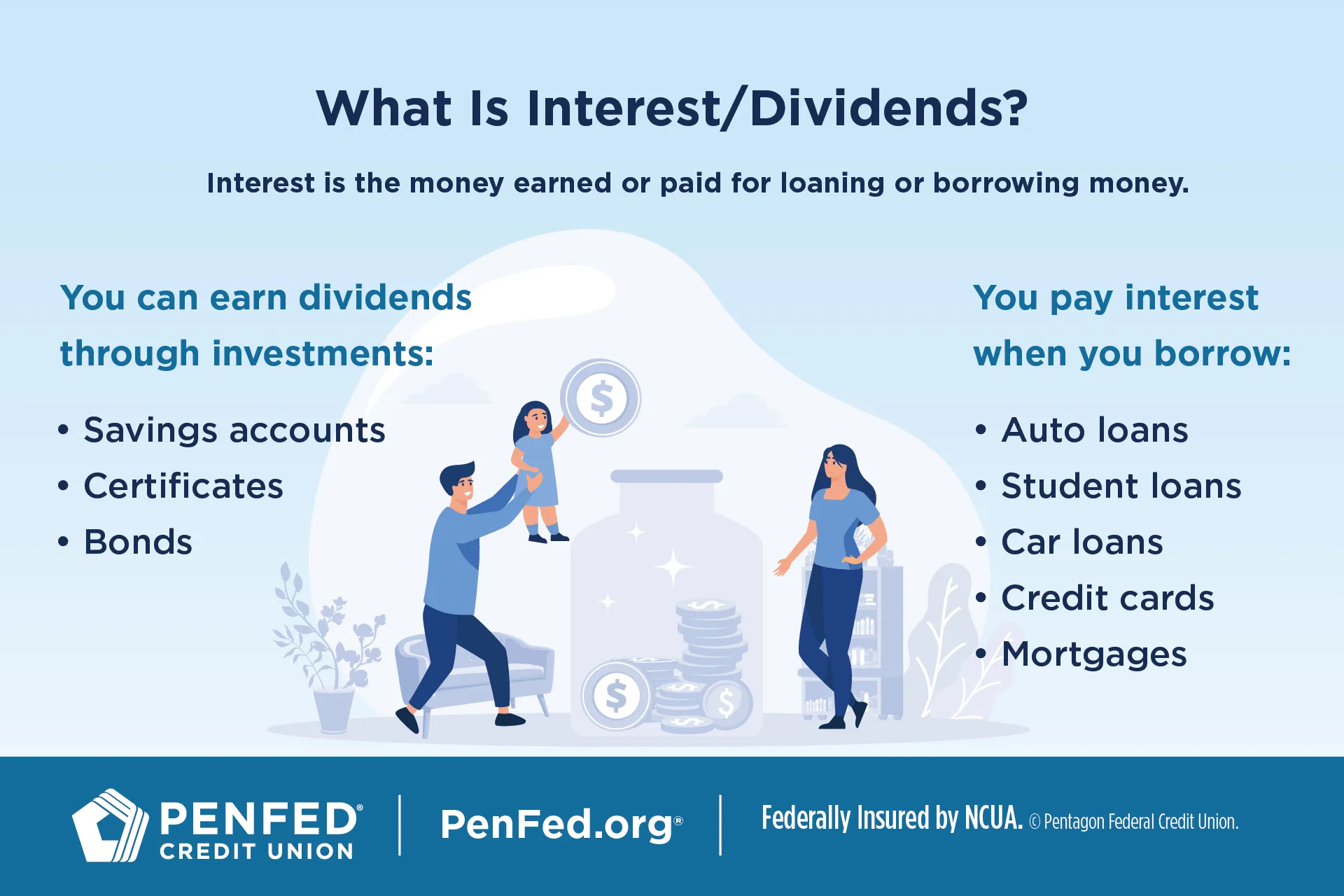
In simple terms, you earn interest (or dividends) when you loan (give out) money, and you pay interest when you borrow money.
When you put your money in an account at a bank or credit union, you’re allowing that financial institution to borrow your money to make loans to other people. In exchange, they’ll pay you interest/dividends.
When you put your money in an account, you’re allowing that financial institution to borrow your money to make loans to other people.
Savings accounts are the most popular way to earn interest/dividends, but there are other ways, such as:
- Certificates (called “certificates of deposit” or “CDs” at banks)
- Bonds
- Interest-bearing checking accounts (note: not all checking accounts earn interest)
You’ll pay interest if you borrow money from your bank, credit union, or another type of lender. You might borrow money through:
Auto loans
Mortgages
Personal loans
Student loans
Credit cards

Interest-Bearing Accounts
Banks and credit unions offer different kinds of accounts. They can be divided into two categories: interest-bearing and non-interest bearing.
Interest-bearing means that an account earns interest for you (like a savings account).
Non-interest bearing means an account does not earn interest for you (like some checking accounts).
Interest-bearing means that an account earns interest for you (like a savings account).
Interest vs. Dividends
The words “interest” and “dividends” mean almost the same thing — money earned or paid for loaning or borrowing money.
Why are there two terms for the same thing? People who become members of credit unions own a little piece of the credit union, similar to buying stock in a company. That’s what “dividends” implies — money earned on your investment in the credit union.
Banks are private businesses run by stockholders. People who use banks are customers, not members. They are paid interest, a word that shows they are customers in a business transaction.
That said, the difference between the two words is subtle, and they’re often used as synonyms.
The words “interest” and “dividends” mean almost the same thing — money earned or paid for loaning or borrowing money.
Interest Rates
An interest rate is the percentage applied to the money you invest or borrow to calculate the interest you earn or owe. It can be written as a percentage or decimal, such as 5% or 0.05.
An interest rate is the percentage applied to the money you invest or borrow to calculate the interest you earn or owe
Types of Interest
Interest on money you borrow can be calculated two ways. The difference is whether you calculate interest based on the principal (meaning the original amount of money borrowed) or the principal plus previously-applied interest.
Simple Interest
Simple interest is “simple” because it doesn’t change. The lender charges a percentage of the amount borrowed, and that’s the total interest charge for the loan term.
Say you borrow $1,000 at a 6% simple interest rate. If you don’t repay any money, you’ll owe $60 on that money this year, another $60 next year, and so on, every year until you repay the money you borrowed, plus interest.
Simple interest is usually used for short-term borrowing, like with auto loans or personal loans.
Simple interest is usually used for short-term borrowing, like with auto loans or personal loans.
Compound Interest
With compound interest, interest is compounded — or calculated and added to the principal — at regular intervals. Depending on the conditions of your loan, these intervals can be daily, weekly, monthly, quarterly, or annually.
If your interest is compounded monthly, then at the end of each month the interest you owe is added to the principal. That means that this month you’ll be charged interest on the original principal plus the interest from the last month.
Compound interest is often used with borrowing options like credit cards, student loans, and mortgages.
Imagine you borrow $1,000 at a 6% rate for one year — but this time your interest compounds monthly. The interest rate applied each month is 1/12 of 6%, calculated by dividing 6% by 12 months: 6% ÷ 12 = 0.5%.
The amounts you’ll owe if you don’t make any payments will be:
- End of Month 1: $1,005.00 (the $1,000 principal plus $5.00 in interest)
- End of Month 2: $1,010.03 (the previous balance of $1,005.00 plus $5.03 in interest)
- End of Month 3: $1,015.08 (the previous balance of $1,010.03 plus $5.08 in interest)
and so on.
By the end of the 12th month, you’d owe $1,061.68. That’s $1.68 more in interest than with the simple interest example. Not a huge difference in this case, but with higher interest rates – like those most credit cards charge -- and longer periods of debt, that extra interest can really add up!
(Note that most people do start making payments on loans and credit card balances after the first month, in which case the amounts owed at the end of each month would be different from the above.)
Compound interest is often used with borrowing options like credit cards, student loans, and mortgages. It’s also used with savings tools like high-yield savings accounts, certificates, and money market accounts.
The more often your interest is compounded, the faster your money (or your lender’s money) will grow.
Think of it this way: If you have $1,000 in an account, and you earn 3.6% compounded annually, you’ll have earned $36 at the end of the year. That’s because your interest is calculated once and paid into the account at the year’s end.
But say you have $1,000 earning 3.6% compounded monthly. At the end of the year, you’ll have earned $39.71. That’s because your interest is compounded (calculated and applied to the total current balance) and paid into the account every month.
Fixed vs. Variable Rate
Interest rates can be described as fixed or variable. Fixed rates stay the same from the time you borrow the money until you’ve completely repaid it. Variable rates can change during the time you’re repaying the loan.
Why would an interest rate change? Interest rates are set based on a number of factors, such as:
- The amount of money you’re borrowing
- Your credit report
- The amount of other debt you have
- Your income
But factors in the economy also affect interest rates. When those factors change, interest rates change in response to them.
Variable rates can change during the time you’re repaying the loan.
Interest Rate vs. APY and APR
Sometimes people throw around the terms interest rate and APY or APR like they’re the same thing. While they’re similar, the differences between them are really important.
Interest Rate (Once More)
Recall that an interest rate is applied to a principal to determine the amount of interest you earn or owe. If interest is compound, it is calculated and paid (or “compounded”) on a regular schedule that can be daily, weekly, monthly, yearly, etc. Your interest rate plays a big part in determining your APY or APR.
What Are APY and APR?
Annual percentage yield (APY) can be an estimate of what your money will earn in one year, including your compounded interest. If you’re borrowing money, annual percentage rate (APR) is an estimate of what you will pay to borrow money, including the interest and any fees related to your loan.
In other words, APY and APR reflect your interest rate and how frequently that interest is compounded. APR potentially also includes any fees applied to a loan. APY and APR are important because two accounts could offer the same rate, but if they’re compounded differently, you could end up earning or owing different amounts of money.
Annual percentage yield (APY) can be an estimate of what your money will earn in one year, including your compounded interest.
For example, say you have $500 dollars. Savings Account A and Savings Account B both offer a compound interest rate of 4%, but Account A compounds daily while Account B compounds quarterly. At the end of one year, Account A would earn $63.74 while Account B would earn $63.41.
You might be thinking that 33 cents isn’t a huge difference, and you’re right. But because of compound interest, the difference in earnings will get bigger over time. In ten years, account A from above would have earned $245.90 in interest, while account B would only have earned $244.43. Additionally, if you had invested a larger amount, you’d see an even larger difference in interest earned.
The Takeaway
Knowing how interest works is a big step toward borrowing money wisely, growing your savings, and even managing your credit score. You’re setting yourself up for a bright financial future!
Explore Savings Account Offerings at PenFed
Discover the diverse offering of products, services, and support available to our members.