


MORTGAGE KNOWLEDGE CENTER
PenFed Mortgage with Confidence

Rates starting at
MORTGAGE
Everything You Need to Know to Create a Smart Home
What You'll Learn: Selecting smart home devices, financing your smart home upgrades, and more.
-
EXPECTED READ TIME: 3 MINUTES

December 18, 2023

Welcome to the world of The Jetsons: the futuristic cartoon TV family whose fully automated household could get George dressed for work, coffee poured, space car ready and waiting, and out the door without a human lifting a finger (although Rosie, the robot housekeeper, did a lot of the legwork). With the advances in smart home technology, we aren’t far behind.
As our lives become increasingly connected, smart homes are no longer a thing of the future, but a reality for many homeowners. Learn about the latest technologies, increase your home's resale value, and explore financing opportunities to make your home smarter and more energy-efficient. Along the way, you'll also discover how smart home technology has evolved and become an integral part of our culture.
Getting started with Home Automation
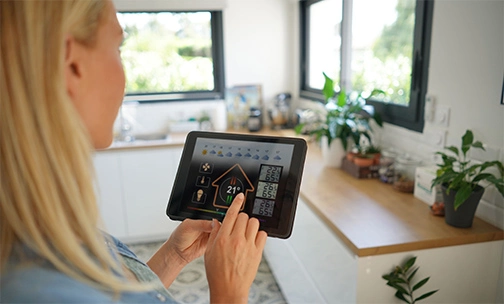
Embrace the future with a smart house that simplifies and enhances your everyday routines. Begin by identifying which aspects of your life you want to improve through home automation. From smart watering to smart thermostats and smart speakers, wireless, “intelligent” technologies are up-leveling virtually every aspect of domestic life. Since the introduction of smart home technology in the early 2000s, the market has grown exponentially. Currently, over 40 million homes in the U.S. have at least one smart device.
Selecting a Hub for your Smart Home
A smart hub is the command center for your smart home, connecting and controlling all of your smart home devices. The market offers various options, with the most popular providers being Apple, Google, and Amazon. Each hub has its unique strengths and weaknesses, and one is likely to work best with your specific needs and preferences.
- Apple HomeKit: Apple's ecosystem is known for its security, privacy, and seamless integration with iOS devices. Notable devices include Philips Hue lights, August smart locks, and Ecobee smart thermostats. The cost of these devices ranges from $20 for a single smart light bulb to $250 for a smart thermostat.
- Google Nest Hub: The Google Hub offers impressive voice recognition and a wide range of compatible devices. Compatible devices include Nest thermostats, Nest cameras, and Google's line of smart speakers. Prices range from $30 for a Google Home Mini to $400 for a Nest camera system.
- Amazon Echo (Alexa): Speakers with Alexa provide a vast selection of compatible devices and excellent voice recognition. Some popular compatible devices are Ring doorbells, Amazon smart plugs, and Sonos speakers. Costs can range from $25 for an Amazon smart plug to $300 for a Ring doorbell system.
Smart Lights, Camera, Action
Transform your living space with these incredible gadgets and technologies, each with a different price range to suit your budget:
- Smart light bulbs: Control your home's lighting from your phone or through voice commands, set schedules, and adjust brightness and colors to suit your mood. Prices start at $15 for a single smart light bulb and can go up to $200 for a complete lighting system.
- Cameras and security: Smart home security systems offer real-time monitoring, notifications, and even facial recognition to keep your home safe. A basic security camera may cost around $100, while a comprehensive system can reach $1,000 or more.
- Smart thermostats: They can save money and energy by learning your habits and adjusting the temperature accordingly. The cost ranges from $100 for a basic model to $250 for more advanced options.
- Music: Smart speakers like Google Home or Alexa devices for the home allow you to control your music with just your voice. Prices start at $30 for an entry-level model and can go up to $400 for a high-end device.
- Smart garage door openers: May be motion sensitive, programmable, or remote-controlled – so you never have to worry about smashed bicycles or whether you left the door open. These devices typically cost between $150 and $300.
What about privacy?
While smart home technology offers numerous benefits, privacy is a real concern for many consumers. To address these concerns, companies are becoming more transparent about their data practices and giving users more control over their data. Consumers can protect their privacy by researching products, choosing companies with strong privacy policies, and keeping software up to date.
Smart home = smart money
Creating a smart home can range from a few hundred to several thousand dollars, depending on the extent of your upgrades. But these improvements may increase your home's resale value, and almost certainly make your home more attractive to certain buyers than an equivalently valued home that’s not wired for efficiency and convenience. In one Coldwell Banker survey, 81 percent of smart-device users said they would be more likely to purchase a home that already has tech in place. You might consider leveraging a home equity line of credit to finance smart home investments.
Unlocking the potential of your smart home
Experience the convenience and improved quality of life that comes with a smart home. Consult with your lender to learn more about financing options and make your home a technological masterpiece. As smart home technology continues to grow and become more integrated into our lives, understanding the available options, costs, and privacy concerns will empower you to make the best decisions for your home and lifestyle.
SIMILAR ARTICLES
 10 Smart Home Features Home Owners Love
Find out about the latest smart home features that can make your everyday life easier and more enjoyable. From climate control to security, discover the top ten.
 Consider a HELOC for Home Improvement Projects
Discover how to use your home’s equity for home improvement projects and renovations. Take advantage of HELOC’s low-interest rates to upgrade your home.
 Home Equity Loan vs. HELOC: What’s the Difference?
There are two different types of home equity loans: a line of credit or a lump sum loan. Discover the pros and cons of each and which one is best suited for what you need.
 10 Ways to Use the Equity in Your Home
Using the equity in your home can be a smart financial move. Check out the top 10 reasons many homeowners consider a home equity loan or line of credit to reach their goals.
Home Buying Steps
Mortgage Products
Disclosures
*Prime Rate is 7.00% as of September 21, 2026. The APR for this Home Equity Line of Credit (HELOC) is based on prime plus a margin and can change monthly. Fixed Rate Advances will be amortized over the Fixed Rate Advance Term, with the payment consisting of principal and interest. Your Annual Percentage Rate for a Fixed Rate Advance will be calculated by adding your Prime Rate, your Margin, and the Additional Fixed Rate Lock-In Margin. Your Annual Percentage Rate for a Fixed Rate Advance shall not exceed 18% and shall be equal to or greater than 7.00% for primary residences and second homes.
- Annual Fee: Notwithstanding the foregoing, an annual fee of $99 will be assessed on each account anniversary.
- Home equity lines of credit (HELOC) are variable rate loans and the interest rate is subject to increase after consummation of the loan on monthly basis. Closing costs range between $500 and $8,500 for credit lines of $500,000. Contact a representative for additional details.
Appraisals: PenFed will attempt to establish value via an independent method. If that method is unsuccessful, or the value is not sufficient for the amount requested, an appraisal will be required regardless of CLTV. An appraisal is always required in the following circumstances:
For all loans with a loan amount greater than $400,000.
If an appraisal is required, it must be ordered by PenFed. You will be contacted for authorization and payment prior to ordering. Appraisal fees average $550 to $850 (some run higher).
- Closing Cost Credit: PenFed will pay most closing costs associated with a home equity line of credit (HELOC), which includes credit report, flood certification, settlement/closing, property ownership and encumbrances search, recording, property search, and quick close. Member is responsible for any city, county, and/or state taxes if the subject property is located in FL, LA, MD, MN, NY, TN, or VA. If an appraisal is required, the member, who is responsible for the fee whether or not the loan closes, will pay the cost.
Interest may be tax deductible, consult a tax advisor for further information regarding the tax deductibility of interest and charges.
Fixed Rate Advances will be amortized over the Fixed Rate Advance Term with the payment consisting of principal and interest. Your Annual Percentage Rate for a Fixed Rate Advance will be calculated by adding your Prime Rate, your Margin and the Additional Fixed Rate Lock-In Margin. Your Annual Percentage Rate for a Fixed Rate Advance shall not exceed 18% and shall be equal to or greater than 7.00% for primary residences and second homes.
Property Insurance: Property insurance is required.
Multiple PenFed Loans: Multiple PenFed Equity loans and HELOCs are available as long as the member and collateral qualify (except Texas). For Equity loans and HELOCs the total indebtedness cannot exceed $500,000 for all PenFed Equity and HELOCs combined.
PenFed does not lend on:
- Mobile homes
- Co-ops or time-shares
- Properties that are currently listed on the market for sale
- Commercial property or property used for commercial purposes, even if a residence is part of the property
- Undeveloped property (land only)
- Properties with more than 4 units
Properties that are currently under major construction/renovations: Property must be fully livable, with no safety issues. (Examples: no missing rails from stairs/decks, no open walls with wires showing, missing kitchen appliances/counters, missing bath fixtures or unfinished pool).
- Additional limitations may apply
Home Equity Line of Credit:
- This Account has a Draw Period of 10 years, followed by a repayment period of 20 years.
- If only minimum payments are made during the draw period, the loan balance will not decrease.
- In Texas, the maximum CLTV available is 80% on owner occupied properties. Additional restrictions apply in Texas, so please ask a representative for details.
- In all other states, the maximum CLTV is 85% on owner occupied properties and second homes. Additional restrictions or requirements may apply based on application characteristics.
- Property type of Condo has a maximum CLTV of 80%.
- The maximum CLTV available is dependent on credit qualification.
- Rates vary depending on owner occupancy and CLTV and other loan criteria.
Minimum Loan Amount Requirements in all States:
- For an owner occupied property or second home the minimum loan amount is $25,000 and the maximum amount is $500,000 with a CLTV of 85% or less of the fair market value.
Other terms and conditions apply; call 844-918-4307 to speak with a representative for details. All rates and offers are subject to change without notice. To receive advertised product, you must become a member of PenFed.





Routing #256078446
©2026 Pentagon Federal Credit Union